
Alongside the legal consequences of the Kiel judgment (8 O 28/11), the criminal offences under §§ 299a and 299b StGB are more topical and perhaps even more relevant to the familiar scenarios involved in the treatment of international patients (also: patient referral). The "newly" enacted provisions are intended to counteract a distortion of competition and an increase in the cost of medical services in the healthcare sector. In addition, they are meant to preserve patients' trust in the integrity of the healthcare system.
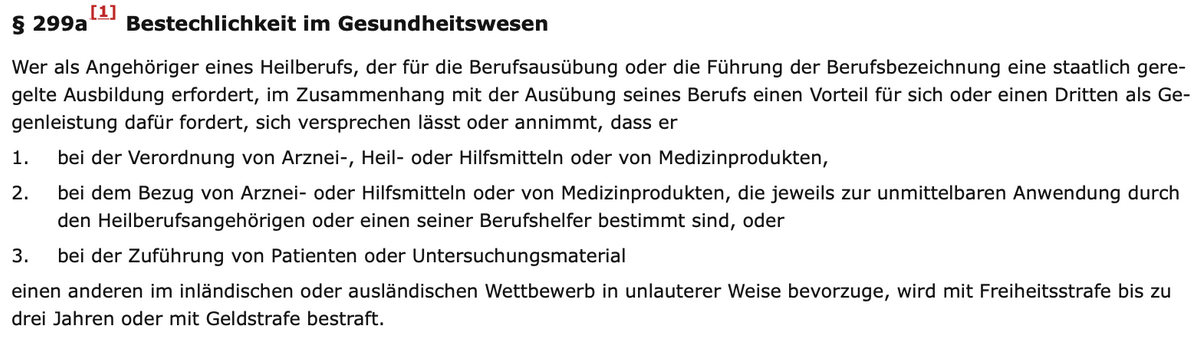
Potential Offenders under §§ 299a and 299b StGB in Medical Tourism
Only members of a healthcare profession fall within the group of potential offenders under § 299a StGB. In principle, anyone can fall within the group of potential offenders under § 299b StGB, but they must act in connection with the professional practice of the healthcare professional. §§ 299a and 299b StGB are therefore only applicable if a physician works for the referral agency. This does narrow the scope of application, since in Germany the referral agencies are almost never physicians. However, because what matters here is neither the place of activity nor where the qualification was obtained, foreign physicians who refer patients from abroad to a German hospital also fall within the group of potential offenders. For example, patients from Africa are frequently referred to German hospitals for payment through local physicians.
Patient Referral as the Criminal Act
The criminal acts comprise demanding, allowing oneself to be promised, and accepting a benefit, and in the case of § 299b StGB, offering, promising, or granting a benefit that is connected with the professional practice of the healthcare professional. Relevant to our consideration here is the channelling of patients.
The concept of channelling is to be understood along the lines of the already familiar concept of assignment set out in § 73 VII SGB V and § 31 MBO-Ä. The aim is to prevent patients from being steered to particular service providers or medical institutions for improper reasons that are not solely medical but instead economic. The agency's manner of operation is therefore of decisive importance. If the agency works with only one hospital, a targeted steering of patients toward the cooperation partner is to be assumed, if not indeed self-evident.
A differentiated view is required here, however. Patients are often aware that the agency cooperates with only one clinic. In such cases it can be assumed that the patient makes the choice himself, since he specifically wishes to visit this clinic but chooses to go through the agency for logistical advantages.
The channelling of patients is more clearly to be rejected where the referral agency cooperates with several institutions and presents these to the patient for selection. Here the channelling is to be affirmed only if the mere recommendation can be regarded as a targeted steering of the patient.
Unlawful Agreement and Preferential Treatment
The element of the offence constituted by the unlawful agreement is present where the consideration for the benefit is an unfair future preference in competition and relates to healthcare-related decisions.
Even where there is no channelling according to the aspects described above, the situation may nevertheless constitute a preference within the meaning of the unlawful agreement, including in the case of cooperation with several clinics.
On this understanding, the unfairness also exists in cases of medical tourism where the referral agency receives its remuneration solely for the channelling of the patient. Only if the agency also receives remuneration for other services, such as translations, visa procurement, and the provision of interpreters, is there no unfair channelling.
Conclusion: The Significance of the Criminal Offences for Medical Tourism
The offences under §§ 299a and 299b StGB have considerable scope for many areas of our healthcare system. This applies equally when they are applied to medical tourism. However, relevant areas of application are disregarded, while cases are included that are borne neither by disloyal intentions nor entail any disadvantage for the patients or other parties involved.
For reasons of prevention as well, hospitals and patient care companies should establish well-conceived processes both internally and in their cooperation with one another. When selecting partners, attention should be paid not only to the legal form but also to characteristics such as demeanour, commercial conduct, and the way patients are treated. In addition, cooperations should be thoroughly documented and the procedures recorded.
Appropriate contract drafting is an important building block for guaranteeing a legally secure and, not least, economically sensible cooperation.