Medical and health tourism is dominated to a large extent by the referral of international patients through so-called patient facilitators, agencies and brokers. And although this has not changed in recent history, it is nevertheless justified to examine whether relying on these parties is an advisable strategy for healthcare providers and destinations in health tourism and medical tourism.
The Advantages of Patient Facilitators
Before we turn our attention to the risks and disadvantages, we should consider the advantages that agencies/facilitators can offer to hospitals and healthcare providers.
Lower Spending on Medical Tourism Marketing
Patient facilitators do not provide medical services themselves. They must therefore market the services of the providers in order to build up and maintain a patient base. Hospitals can benefit from this, as they can concentrate on their domestic marketing activities and leave international marketing to a group of people who better understand the needs and requirements of foreign patients. It offers a way to reduce spending on global market activities. It also saves other resources, such as time, since the need to be present at international trade fairs and exhibitions is eliminated.
Guaranteed Return on Investment
Cooperation with patient facilitators also opens up the possibility of a guaranteed return. The return is guaranteed by the nature of the business, since hospitals only pay a referral fee or commission once the treatment has been completed. Although this practice has been criticized and even banned in some countries (including Germany), it remains the most prevalent way in which the medical tourism industry operates. In this way, hospitals do not deploy a marketing budget that they would not recover as a result of unsuccessful campaigns.
Lower Administrative Effort
By involving a third party responsible for collecting all relevant patient information and documents as well as for the logistical support of the patients, hospital staff do not have to be entrusted with these tasks. Caring for international patients involves a considerable administrative burden. Commissioning a professional and experienced organization to handle this workload brings operational efficiency to hospitals and can avoid an increased need for staff. Considering that staff must be appropriately trained in intercultural relations, this can have significant implications for a hospital.
Risks of Cooperation with Patient Facilitators
You might stop reading at this point and overlook the truly critical part: the disadvantages of cooperating with patient facilitators. This goes far beyond my personal opinion on this subject. In Germany alone, there are numerous examples that show what a great risk you take for patients and your institution when you work with medical tourism agencies.
The following graphic shows some of the problems that can arise from involving facilitators in patient care.
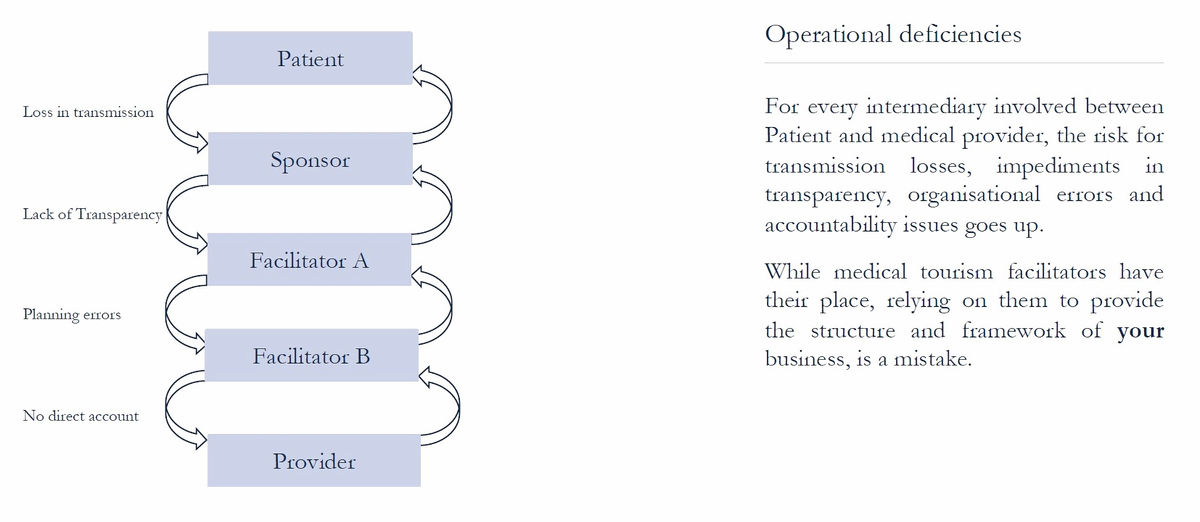
In many cases, patients first turn to a sponsor. This may be a ministry that covers the cost of treatment, a consulate or even an insurance company. This party turns to a facilitator, who often needs another facilitator in the destination country to organize the treatment and ensure that the travel arrangements are tailored to the treatment plan and the individual conditions of the request.
Increased Costs for Medical Tourists
Each additional participant contributes, if not to value creation, then at least theoretically to the administrative effort in the process chain. This administrative effort must be compensated for in one way or another, which regularly increases the price either directly for the patients or for the sponsor. It is correct that whoever delivers value to the process should be compensated, but it remains questionable whether so many facilitators are really necessary to accomplish the task. At some point, the increase in costs is no longer justified by the added value. Moreover, patients often do not know what the process looks like in detail and thus have no control over how many parties are brought in.
Medical Tourism Is Susceptible to Miscommunication
Involving various third parties increases the risk of miscommunication. Whatever the patient wishes to communicate is passed on, to the point where an alteration of the actual concern is almost inevitable. Every facilitator has motives and intentions that are rarely set aside. As a result, what the patient originally communicated often does not reach those involved in exactly the same form. A direct account by the patient reaches the treating physician only in the rarest of cases, which can have a negative impact on the entire patient experience.
Patient Facilitation: Opaque Motives
In a perfect world, we could assume that the only motivation of medical tourism providers and patient facilitators is to make the well-being of the patient their top priority. Unfortunately, however, we do not live in a perfect world. It is part of the reality of every business that financial incentives are at the center. The choice of provider is therefore strongly influenced by the expected economic return. A patient-oriented decision is thus not guaranteed and is even rather unlikely. In addition, patients are only rarely involved in decisions. Patient autonomy, as an essential factor in shaping patient-oriented healthcare, fades into the background.
Lack of Ownership and Lack of Control
Hospitals allow a large operational gap in their organization when they rely on facilitators. They have no influence on market developments and are not prepared to acquire international patients if the cooperation between them and a medical tourism facilitator fails. Facilitators often have a disproportionately large influence on patient flows and thus exert remarkable market power. They determine where the patients go, which information reaches whom, the pricing and even how a hospital is perceived by the patients and the outside world.
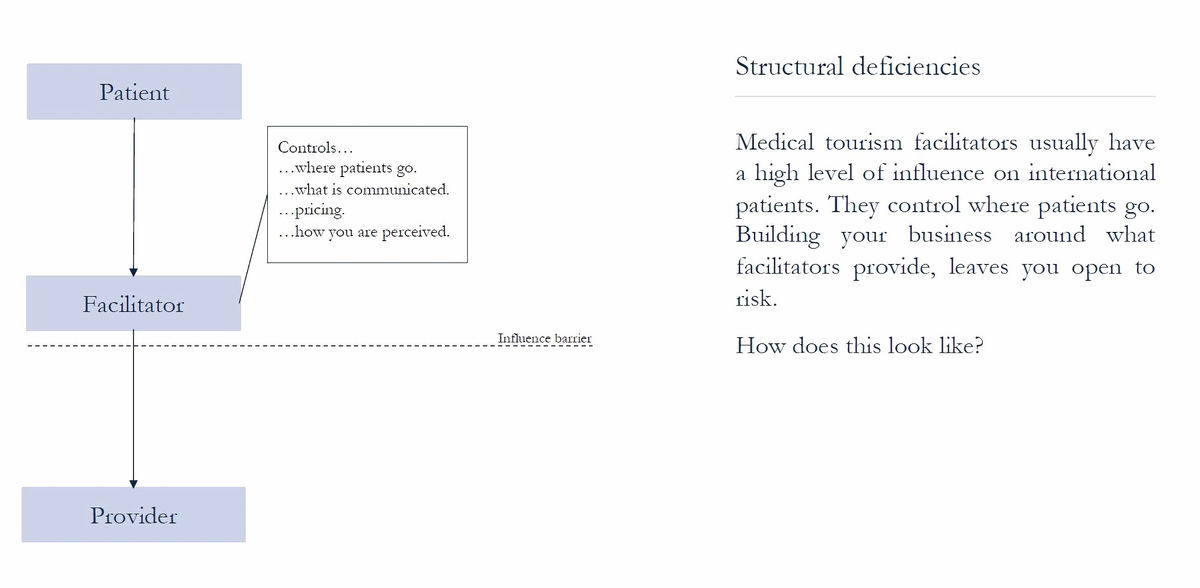
The parties involved are themselves responsible for whether cooperation with facilitators in the field of medical tourism will be successful. It depends on the choice of facilitation partner and the internal policy of the hospital as to what it expects from its partners in terms of best practices, transparency and commitments to operational procedures. There are great organizations, both facilitators and hospitals, that work continuously to provide an excellent patient experience by placing the patient unconditionally at the center. Nevertheless, it is important to be aware of the potential risks in order to avoid entering into a cooperation with unwarranted optimism.
If you enjoyed this article, you are warmly invited to leave a comment. If you would like to learn more about the topic or about medical tourism in general, please feel free to contact us.